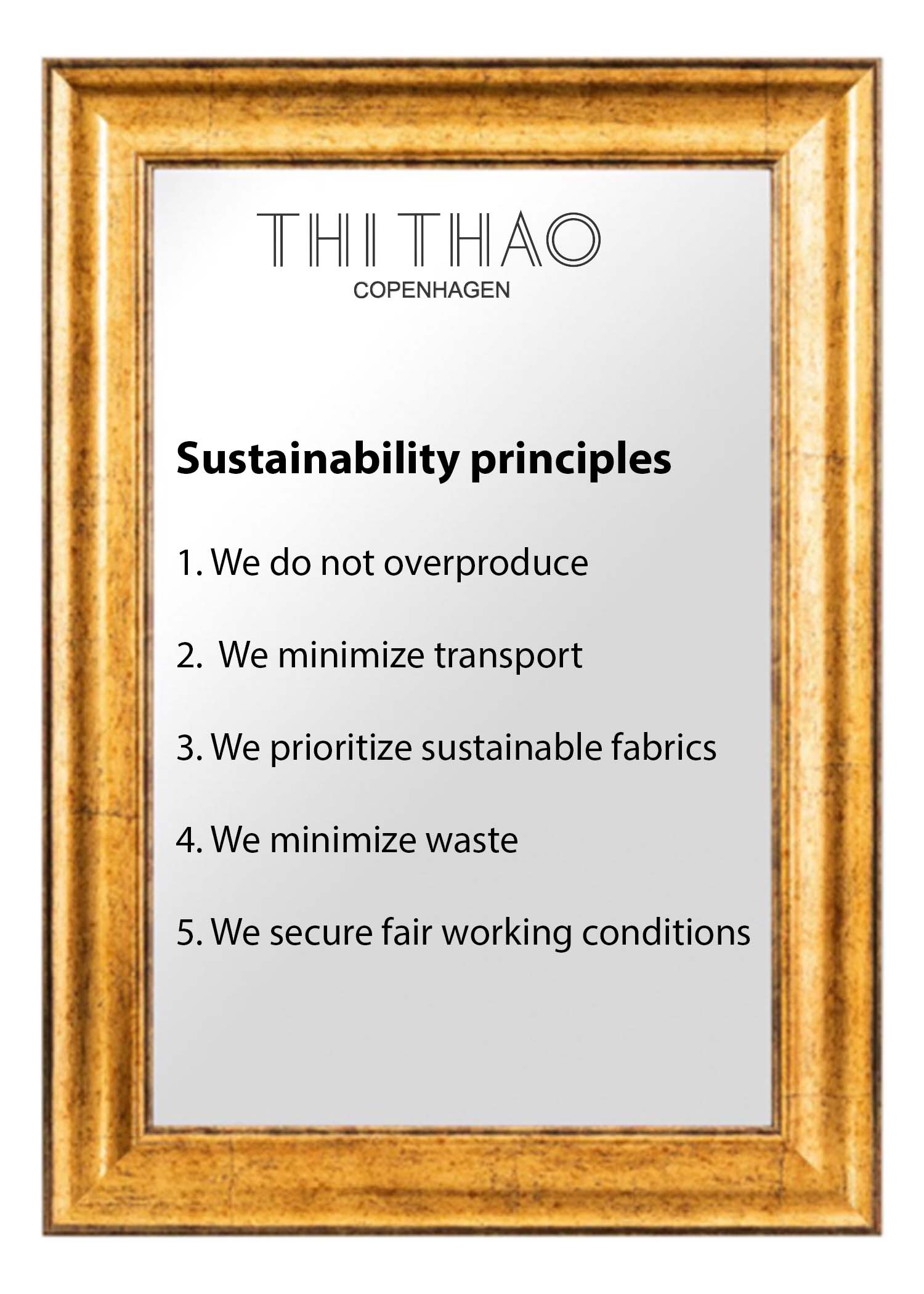
We want Thi Thao Copenhagen to be a sustainable company. We have narrowed down our thinking to 5 sustainability principles.
There are many records of how the fashion industry contributes significantly to the global CO2 pollution. The Geneva Environment Network sums it up pretty well: https://www.genevaenvironmentnetwork.org/resources/updates/sustainable-fashion/
We have purposefully built Thi Thao Copenhagen as a company where we strive for environmental harmony based on our sustainability principles.
We do not claim to be CO2 free – we have too many suppliers to reliably make such a claim, but we are guided by 4 sustainability principles that help us minimize the environmental impact of our production and 1 principle to secure fair working conditions for those producing our clothes.
We do not over-produce
10-40% of the clothes produced in the world is excess production that ends up as waste without benefitting any consumers.
We calculated 10% overproduction to equal 223,5 million tons of unnecessary CO2 emission annually. This is more than the combined CO2 emission from all Nordic countries.
On top of this you can add all the CO2 from transport of excess production that often has to be circulated between different sales points – because it is excess production.
Our way to reduce excess production is to only make a few samples for our customers to try/buy. Most of the clothes we sell are made to fit the individual customer
For the consumer this provides a vast number of customization options. 80% of our customers use their customization options to choose their own colors and influence the fabrics we make their clothes in.
We minimize transport
CO2 emissions from transport remains a major environmental challenge. Depending on the global willingness to change the status quo, we believe this has the potential to reshape value chains.
Transporting fabrics and other materials to our production facilities is unavoidable. We trust the transport sector is working hard to reduce their impact. What we can do in this respect is limited to reducing our transport needs.
We therefore consciously produce our clothes as close to the end user as possible. If you visit our flagship store in Copenhagen, you will notice that our production is located directly under our store.
Our short supply lines benefit consumers with quick delivery despite the significant customization options we offer.
We prioritize sustainable fabrics
To understand how toxic fabric production CAN be, you can easily find pictures online of the damages suffered by cotton fields workers. The basic fact is that chemicals used in fabric production remain in the fabric when you purchase the clothes.
Avoiding toxic fabrics is both about looking after you as a customer and our own employees making the clothes. After all, our skin is our largest organ, and to us it is common sense to limit the toxics we as humans expose ourselves to.
It is also promoting and supporting those companies that make an effort to minimize both the chemical effects on our planet, and those working to create sustainable alternatives.
We prioritize sustainable fabrics whenever possible. Our condition for choosing sustainable alternatives is that they are not of inferior quality to their non-sustainable alternatives.
This is an area that enjoys significant attention, and we are ready to full-heartedly embrace the good that comes from the innovative work of the world’s fabric manufacturers. We are happy to contribute to the increased use of sustainable fabrics in fashion production.
To us, quality and functionality are keys, and they are not easily replaced with cheaper alternatives. Around 95% of the clothing fibres we use are natural fibres such as wool or silk. If we need to use cotton, we will try to find a sustainable, ecological cotton.
All research we con find shows natural fibres are hard to beat. Silk and wool items remain in consumers wardrobes for long, and are worn considerable more times than garments made from synthetical fibres. Many items are still worn 10 years after their purchase. Se e.g. Woolmark + Nielsen data; 2018 meta-analysis)
For the remaining 5% of fibres used in our production we also prioritize sustainable alternatives if they are available. This could be fabrics from regenerated fabric fibres, overproduce from other fashion houses or certified sustainable fabrics.
You can check out some of our products in our webshop.
We minimize waste
Textile production, clothing production and throw-away of used clothes all contribute with tons of waste. A 2025 report by Boston Consulting Group (BCG) suggests that global textile waste reached ≈ 120 million metric tons in 2024 BCG publication.
Reducing overproduction in itself reduces waste, but we go further than that.
- We buy fabrics in small quantities and order special colors cuts when customers order these. This limits fabric production to the colors that are actually sold
- We always place patterns carefully to minimize waste. This maximizes the utilization of each and every fabric we use.
- Cut-offs are collected and given to schools and refugee institutions where they help children develop their creative skills. Schools and institutions can click HERE to contact us about receiving cut-offs.
The fact that many of our fabrics are not ordered until they are needed for specific customers allows us to purchase high-quality fabrics despite their usually higher cost per meter. Quality and price are related – this also applies to fabrics – and using high-quality materials allow us to produce clothes that usually extends the life-time of the clothes.
As a consumer you benefit from our waste reduction policy through extended customization options rather than just choosing between a few readymade designs in a few predefined colors.
Accidents happen and people change. Our after sales services help our customers extend the life-time of their clothes. Our tailor workshop helps repair Thi Thao clothes if they should break, and in our Vintage section, you can sell Thi Thao clothes you know that you will no longer need.
We secure fair working conditions
The textile industry has a long history of chasing for low unit costs. In many cases this results in poor working conditions, low salaries and exploitation of the work force. Here is a credible source to read more: Walk Free / Global Slavery Index — “Stitched with slavery in the seams”
We own our production. This ensures fair working conditions at least for those producing our clothes. Our Nordic heritage makes it natural to us to treat our employees as equals.
It starts the day we interview a potential employee. We hire based on skills, personality and team fit. No matter which CV you bring, we base our hiring process on a practical test designed to showcase skills, inadequacies and potential to fit the role we are interviewing for.
Our salaries are industry standard. We do not aim to attract employees through salaries alone. We do aim to offer jobs that make it a joyful experience to go to work. Sometimes this means adjusting work hours or the length of holidays. We are flexible – and in return our employees are flexible when our customers need them to be so.
We frequently hire for potential – i.e. when we see sufficient eye for detail and quality but lack of speed due to inexperience or language barriers. In these cases we might tailor an individual onboarding plan that balances our needs as a business and the individual’s need to train certain skills. The objective of such a plan is always to be of mutual benefit to the employee and us as a company.
We have suppliers of machinery and raw materials. If we have a feeling a supplier does not provide fair working conditions for their employees, we will replace that supplier.
If you are interested in our open positions you can follow this link.